
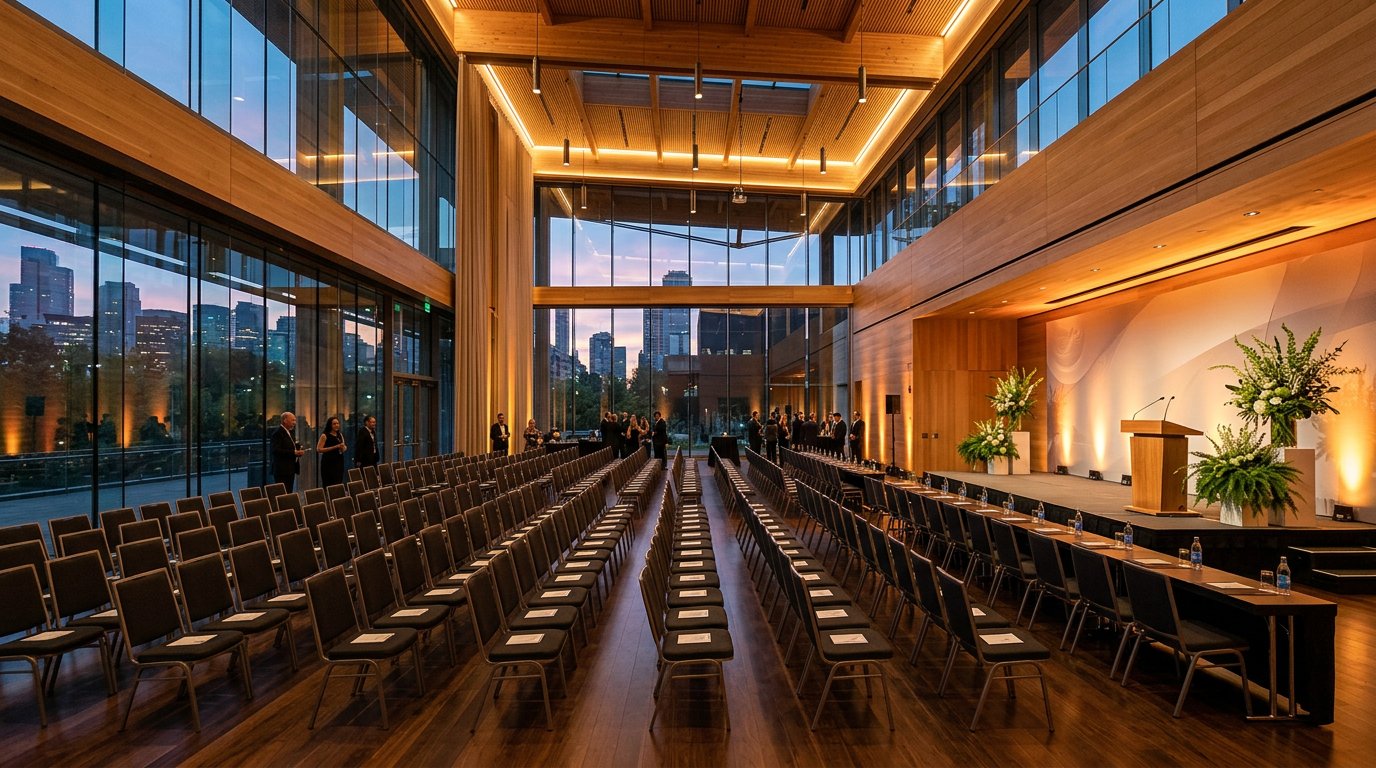
Defining Event Purpose, Audience Needs, and Measurable Objectives
Every well-organized event begins long before a venue contract is signed or a catering menu is reviewed. The most common source of budget overruns and attendee fatigue is an unclear brief: attempting to host a training seminar, a client appreciation dinner, and a product showcase inside a single unfocused agenda. Establishing a written Event Charter aligns internal stakeholders around concrete operational parameters.
During the initial scoping meeting, organizers should document four foundational pillars:
- Primary Purpose & Format: Clarify whether the gathering is designed for knowledge transfer (conferences, continuing-education workshops), relationship building (executive roundtables, networking receptions), organizational alignment (annual town halls), or public engagement (exhibitions, community forums).
- Audience Profile & Accessibility: Estimate realistic attendance based on historical registration conversion rates (typically 55% to 75% for complimentary corporate registrations and 80% to 92% for ticketed professional programs), travel distance, mobility considerations, and scheduling constraints.
- Stakeholder Responsibilities: Assign a single project lead with decision-making authority over scope changes, supported by dedicated owners for venue logistics, speaker coordination, attendee communications, and financial reconciliation.
- Practical Evaluation Metrics: Choose observable indicators—such as session attendance retention, net attendee satisfaction survey scores, per-attendee cost variance, and post-event follow-up completion—rather than vague awareness goals.
Key Principle: Scope Discipline
Adding unbudgeted program elements within the final 30 days—such as extra breakout rooms, custom stage fabrication, or rush-printed signage—frequently increases vendor labor and freight charges by 20% to 40%. Locking core program architecture early protects both team bandwidth and financial predictability.
Building a Structured Production Timeline & Team Workflow
Successful event organization converts hundreds of interdependent tasks into a reverse-engineered schedule anchored to the event date. Working backward from load-in day highlights critical lead times for municipal permits, audio-visual rigging approvals, hotel room blocks, and accessible dietary planning.

Select a planning horizon below to inspect the core operational deliverables typically completed during each stage of a mid-to-large corporate or institutional gathering:
Realistic Event Budgeting and Vendor Cost Allocation
Sound financial management separates estimated baseline expenses from variable per-person costs. Fixed expenses—such as ballroom rental, stage lighting rigs, livestream encoding, and graphic design—remain relatively steady regardless of whether 140 or 180 guests attend. Variable expenses—including plated meals, beverage packages, printed workbooks, and badge lanyards—scale directly with confirmed attendance.
While exact allocations shift based on geographic market and program complexity, experienced planners typically benchmark U.S. corporate and institutional event budgets using the following proportional framework:
| Expense Category | Typical Share | Primary Cost Drivers & Contract Considerations |
|---|---|---|
| Venue & Facility Operations | 22% – 28% | Space rental, setup/teardown hours, loading dock labor, dedicated Wi-Fi bandwidth, power drops, and cleaning fees. |
| Catering & Hospitality | 25% – 32% | Food and beverage minimums, service charges (often 20%–24%), local hospitality taxes, and continuous refreshment breaks. |
| Audio-Visual & Production | 16% – 22% | Projection or LED displays, line-array audio, wireless microphones, stage lighting, technician day rates, and rehearsal hours. |
| Program, Speakers & Signage | 10% – 14% | Speaker honoraria and travel, directional wayfinding boards, stage backdrops, and accessible printed or digital schedules. |
| Registration, Staffing & Insurance | 8% – 10% | Check-in kiosks, on-site event coordinators, security personnel, general liability insurance, and municipal permits. |
| Contingency Reserve | 10% – 15% | Dedicated buffer for weather tenting, last-minute AV adapters, overtime union labor, or unexpected shipping surcharges. |
Methodology Note: Percentages above reflect general planning benchmarks for U.S. in-person conferences and corporate gatherings. Actual vendor pricing varies significantly by metropolitan region, season, union labor rules, and venue exclusivity policies.
Preliminary Event Budget Estimator
Use this planning calculator to model an illustrative budget distribution based on event format, expected guest count, production tier, and contingency buffer.
-
Venue & Facility Rentals $10,900
-
Catering, Beverage & Service Fees $13,000
-
Audio-Visual, Lighting & Staging $8,700
-
Signage, Registration & On-Site Staffing $6,200
-
Contingency Reserve (12%) $4,700
Informational Estimate Only: Figures are generated for preliminary educational planning and do not represent a formal price quote or binding offer. Request itemized local vendor proposals before finalizing budgets.
Venue Selection, Accessibility, and Audio-Visual Production
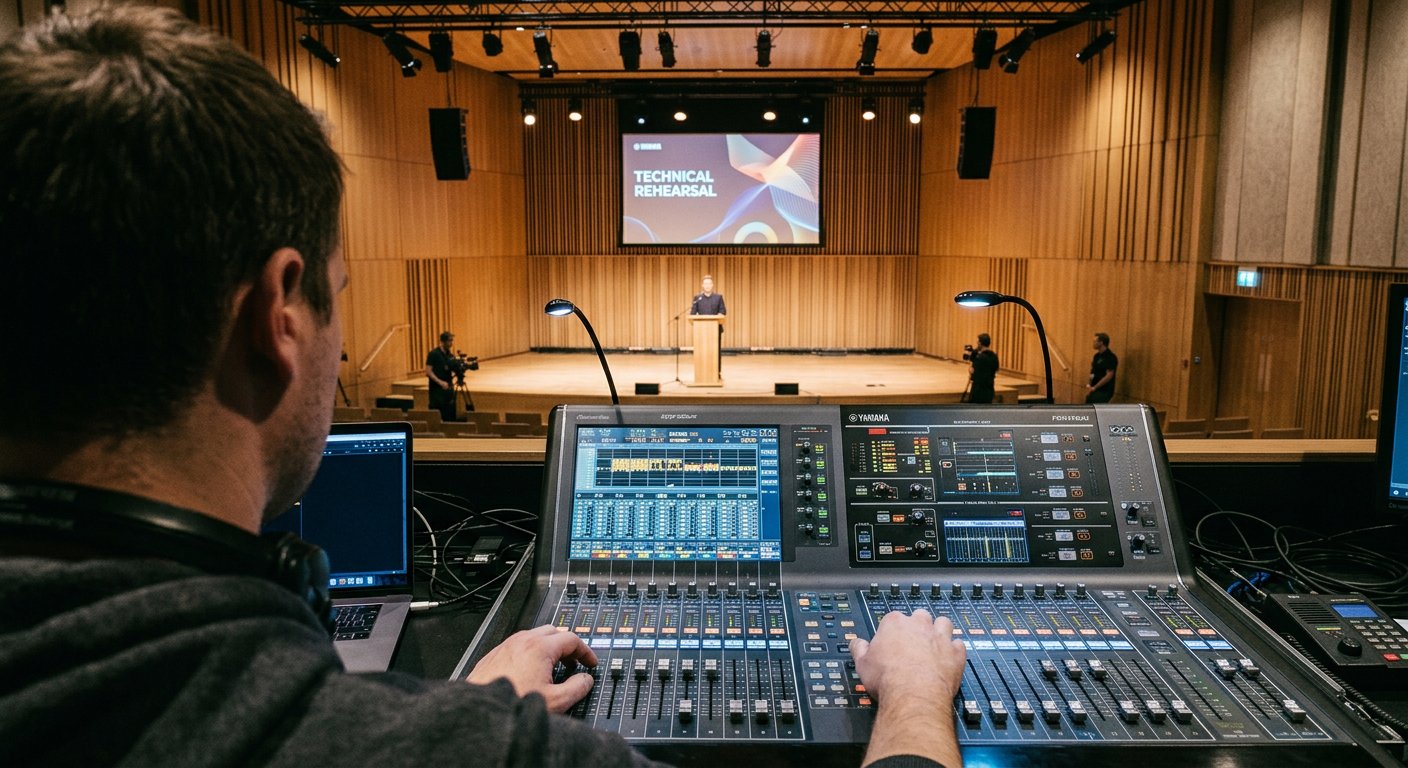
A venue dictates far more than visual atmosphere—it governs acoustic intelligibility, guest circulation, catering speed, and technical labor costs. When evaluating spaces, organizers should measure functional capacity rather than maximum fire-marshal capacity; a ballroom rated for 400 theater-style seats may comfortably hold only 220 attendees once a stage apron, front-of-house mixing desk, accessible wheelchair seating zones, and camera platforms are installed.
Essential Technical & Structural Checkpoints
Acoustic Clarity & Sightlines
Verify ceiling height and column placement from the back corners of the room. Hard glass or concrete rooms often require distributed delay speakers and acoustic drapery to prevent echo during Q&A sessions.
Network & Power Redundancy
Separate production internet (registration check-in tablets, livestream encoders, presenter laptops) onto a dedicated hardwired VLAN distinct from public attendee Wi-Fi networks.
Universal Accessibility (ADA)
Confirm step-free routes from parking and transit drop-offs to registration desks, restrooms, dining spaces, and stage ramps, alongside live captioning or assistive listening support.
Full Technical Rehearsal
Schedule uninterrupted rehearsal time for every presenter to test clickers, confidence monitors, lapel microphones, and walk-up transitions on the actual stage.
Registration Flow, Catering Logistics, and On-Site Safety
Attendees form their lasting impression of an event within the first ten minutes of arrival. Long check-in queues, confusing hallway signage, or poorly labeled allergens immediately erode goodwill—even if the keynote program is exceptional. Designing frictionless guest flow requires viewing the venue through the eyes of a first-time visitor arriving ten minutes before the opening remarks.

- Check-In Throughput Calculations: Plan one staffed check-in or badge-pickup lane per 75 to 90 expected arrivals during peak 30-minute arrival windows, plus a clearly marked "Help & Speaker Desk" so complex badge changes never stall the main line.
- Inclusive Catering & Traffic Flow: Use double-sided buffet islands rather than single-wall tables to cut meal service time in half. Place clear ingredient and allergen cards at every dish, and maintain a separate station for severe food allergies to prevent cross-contact.
- Sustainable Resource Practices: Coordinate with venues to provide bulk hydration stations, reusable serviceware, digital agenda QR boards, badge lanyard collection bins at exits, and verified local food-recovery partnerships where permitted by health codes.
- Emergency Preparedness & Duty of Care: Maintain a written Incident Response Plan containing nearest medical facility addresses, venue security extensions, weather shelter locations, AED placement maps, and designated staff communication channels.
Frequently Asked Questions About Event Organization
For a 150- to 300-person conference or symposium, securing desirable metropolitan venues and hotel blocks typically requires 6 to 9 months of lead time. Smaller single-day executive workshops (30 to 75 attendees) can often be organized effectively in 8 to 12 weeks if venue availability is flexible and technical production requirements are straightforward.
The most frequently overlooked line items include mandatory venue service charges (often 20% to 25% added to food, beverage, and sometimes AV), municipal occupancy and sales taxes, dedicated conference Wi-Fi bandwidth fees, electrical power drop fees per booth or stage, drayage (material handling from loading docks), and overtime labor charges if teardown runs past contracted hours.
In-house AV teams know the building's rigging points, house sound system, and power infrastructure intimately, making them convenient for standard breakout rooms. However, for multi-stage conferences or custom scenic designs, requesting a competitive bid from an independent production company can offer specialized crew continuity—just verify upfront whether the venue charges an external-vendor supervision or rig-patch fee.
Paid conferences and mandatory internal summits typically see 85% to 92% attendance among registrants, whereas free open-registration seminars often experience 30% to 45% no-show rates depending on weather and calendar timing. Sending a one-click attendance confirmation reminder seven days prior—paired with an easy cancellation link—substantially improves catering headcount accuracy.
Within 48 hours, send a concise attendee survey (5 to 7 focused questions) while impressions are fresh, and share promised session resources. Internally, host a structured 45-minute debrief with production and hospitality leads, reconcile final vendor invoices against contracted estimates, and archive the updated Run-of-Show and budget variance report as a baseline for future programs.